
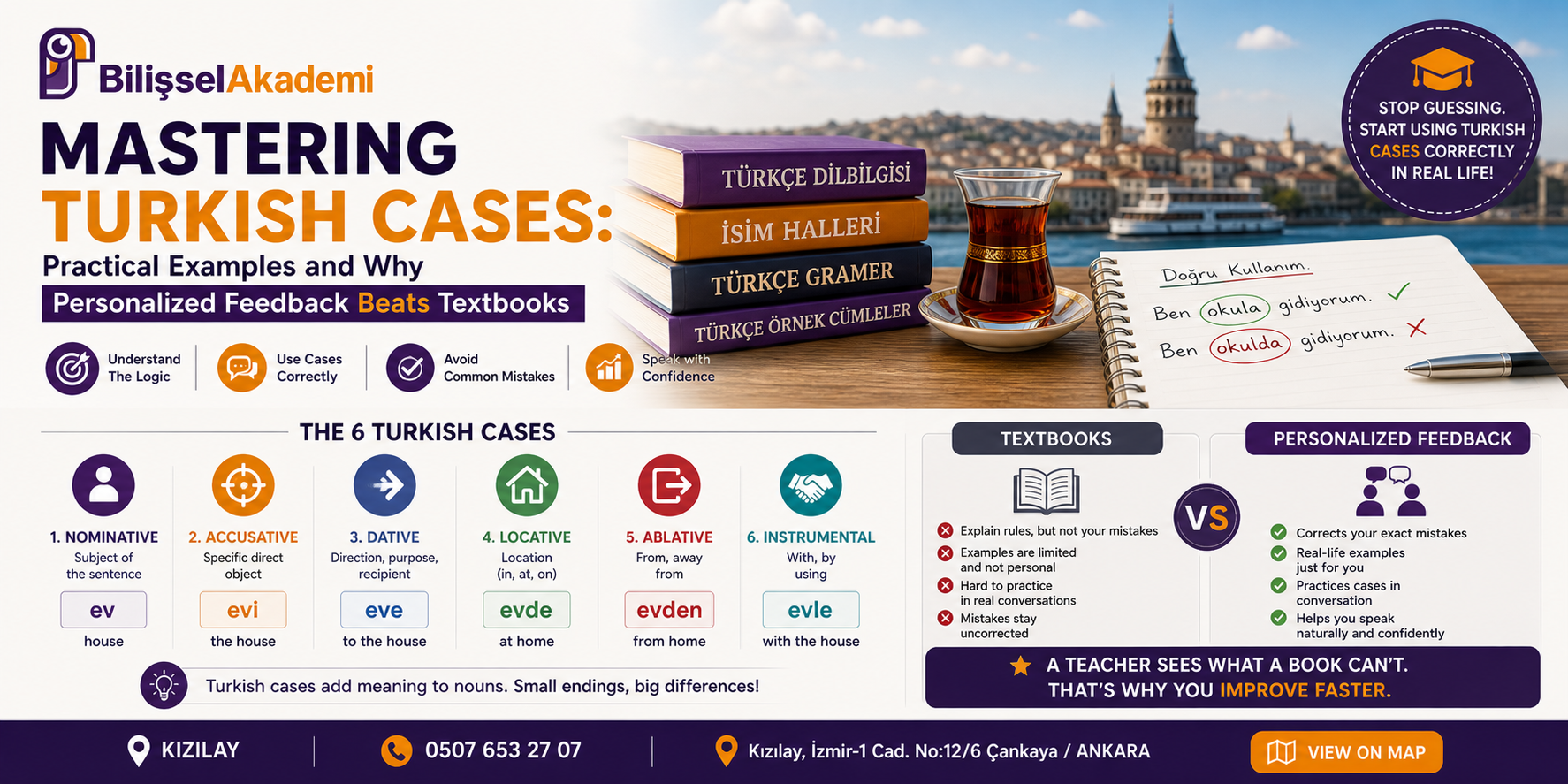
🧩 Mastering Turkish Cases:
Practical Examples and Why Personalized Feedback Beats Textbooks
Turkish cases are undeniably one of the most confusing grammar topics for foreign learners. Many students grasp the basic idea while reading a textbook, but the moment they try to speak, their brain freezes. They constantly confuse essential endings like -i, -e, -de, and -den.
This happens because Turkish cases are not just abstract grammar rules to memorize. They are the driving force of the sentence. They indicate direction, location, movement, specific objects, and the relationship between words. Without them, a sentence falls apart.
To use them correctly in real-time, learners need more than static charts. They need practical, real-world examples, intense speaking practice, and precise, personalized feedback from a professional. This guide breaks down the core cases and explains why VIP tutoring at Bilişsel Akademi Kızılay is the fastest way to master them.
What Are Turkish Cases?
Turkish cases are suffixes added directly to nouns. They show what role a noun has in the sentence. In English, these meanings are usually shown with separate prepositions such as “to,” “in,” “from,” or “with.” In Turkish, the meaning is glued right onto the word itself.
Breaking Down the 4 Core Cases
1. The Accusative Case (-i, -ı, -u, -ü)
Used for a specific direct object. It shows you are talking about “the” specific thing, not just any thing.
- Kitap okuyorum. (I am reading a book. – Any book)
- Kitabı okuyorum. (I am reading the book. – Specific book)
- Kahveyi içiyorum. (I am drinking the coffee.)
2. The Dative Case (-e, -a)
Shows direction, movement toward, purpose, or recipient. It essentially means “to” in English.
- Okula gidiyorum. (I am going to school.)
- Eve geliyorum. (I am coming home.)
- Sana mesaj gönderdim. (I sent a message to you.)
3. The Locative Case (-de, -da, -te, -ta)
Shows static location. It usually translates to “in,” “at,” or “on” in English.
- Evdeyim. (I am at home.)
- Masada kitap var. (There is a book on the table.)
- İstanbul’da yaşıyorum. (I live in Istanbul.)
4. The Ablative Case (-den, -dan, -ten, -tan)
Shows movement away from something, origin, or source. It often means “from.”
- Evden çıktım. (I left from the house.)
- Ankara’dan geliyorum. (I am coming from Ankara.)
- İşten sonra görüşelim. (Let’s meet after work.)
Practical Case Practice for Real Life
Turkish cases become vastly easier when you stop memorizing tables and start practicing them in sequential, real-world situations. Notice how changing one letter completely alters the scene:
🚶♂️ Bankaya gidiyorum. (I am going to the bank. – Direction)
🧍♂️ Bankada sıra bekliyorum. (I am waiting in line at the bank. – Location)
🏃♂️ Bankadan çıktım. (I left the bank. – Movement away)
Why Textbooks Are Not Enough
A textbook can provide rules and examples, but it cannot hear how you speak or explain why your specific answer sounds unnatural.
- Learners understand the rule visually but freeze when speaking.
- Mistakes go uncorrected and eventually become permanent habits.
- Students do not realize which case they personally confuse the most (e.g., mixing up evde and eve).
- Grammar remains passive instead of becoming an active communication tool.
The Power of Personalized Feedback
Personalized feedback fixes the exact mistakes you make in real sentences. A professional tutor listens to your speech and instantly redirects your logic.
- If you say “Ben okulda gidiyorum,” a tutor instantly explains that movement requires the dative case (okula), not locative.
- You drill the correct form in real conversations until it is a reflex.
- You stop guessing and start speaking with unshakeable confidence.
Master Turkish Grammar with Bilişsel Akademi Kızılay
Turkish cases are difficult at first, but they become remarkably clear with consistent practice and professional correction. The key is not merely memorizing the suffixes, but using them accurately in rapid, real-world communication.
If you feel perpetually confused by -i, -e, -de, and -den, you are not alone. With VIP personalized feedback from the expert Turkish tutors at Bilişsel Akademi Kızılay, you can permanently correct your mistakes and start speaking Turkish with absolute clarity.
Book Your Private Grammar Session:
📍 Kızılay Branch
Ziyabey Cad. No: 15/4 (Next to Metro) Çankaya / ANKARA