
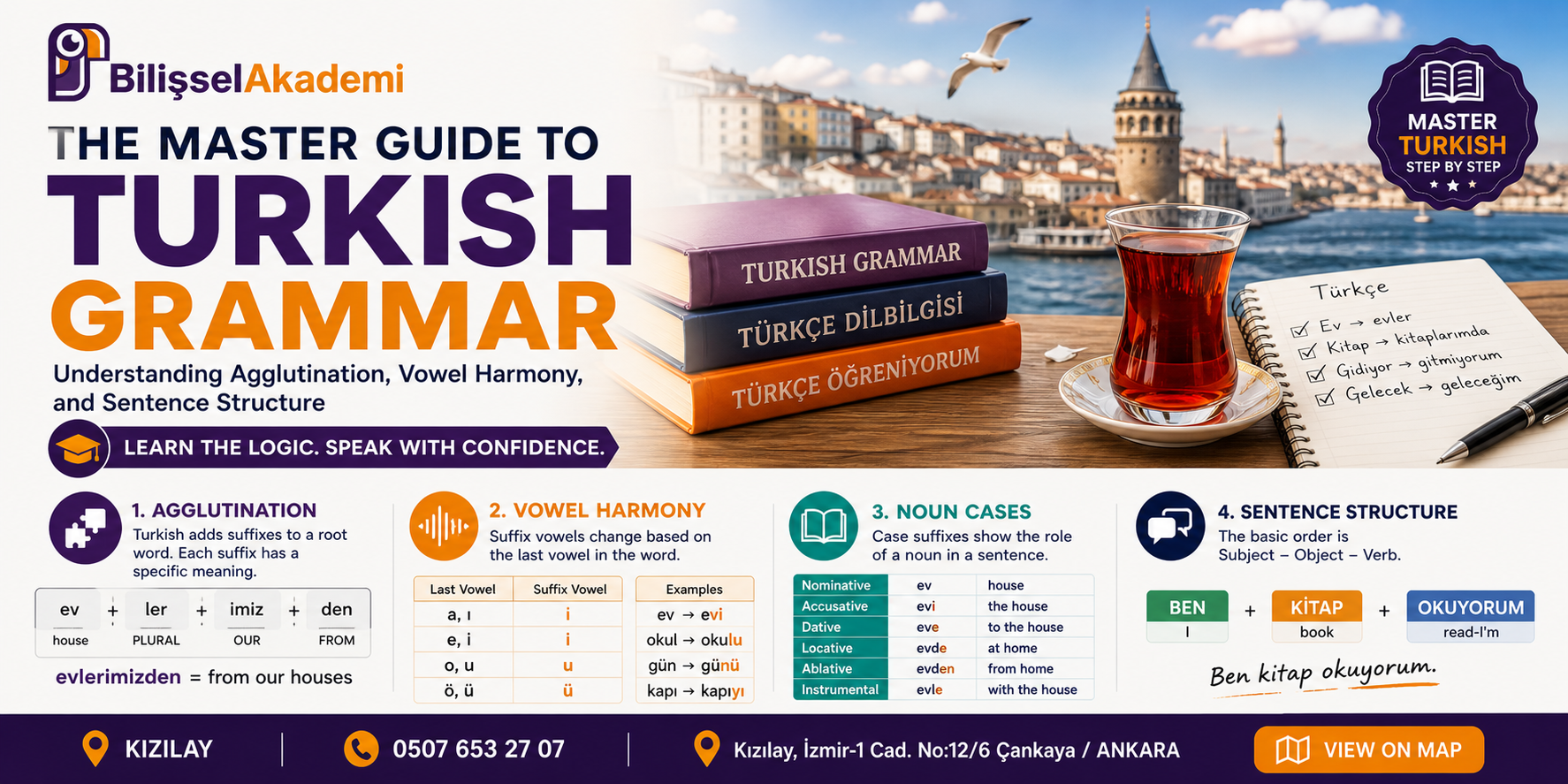
📚 The Master Guide to Turkish Grammar:
Understanding Agglutination, Vowel Harmony, and Sentence Structure
Turkish grammar can seem difficult at first glance because it operates quite differently from English and many Indo-European languages. Words may look incredibly long, suffixes change form constantly, and verbs are usually pushed to the very end of the sentence. However, Turkish grammar is anything but random. It is highly logical, mathematically structured, and much easier to grasp once you decode its core system.
This master guide breaks down the foundational rules for foreign learners. By understanding agglutination, vowel harmony, noun cases, and sentence structure, long Turkish words will stop looking like puzzles. Once you master these foundations, reading, writing, and speaking Turkish becomes a straightforward, predictable process.
Why Turkish Grammar Feels Different: The Magic of Agglutination
Turkish is an agglutinative language. This means that words are built like Lego blocks by adding suffixes to a root word. Each suffix adds a single, specific layer of meaning, such as plurality, possession, location, or tense.
Because of this, one single Turkish word can express an entire sentence that would require several separate words in English.
The Golden Rule: Turkish Vowel Harmony
Vowel harmony is the absolute most important rule in Turkish grammar. Suffix vowels literally change to match the last vowel of the root word, ensuring the language sounds smooth and melodic.
Two-Way Vowel Harmony (a/e)
Used for plurals (-lar/-ler) and location cases (-da/-de).
Back Vowels (a, ı, o, u) take A.
Front Vowels (e, i, ö, ü) take E.
- okul + da = okulda (at school)
- ev + de = evde (at home)
- araba + lar = arabalar (cars)
- gün + ler = günler (days)
Four-Way Vowel Harmony (ı/i/u/ü)
Used for possessives, question words, and tenses. The correct vowel depends precisely on the final vowel of the word.
- Last vowel a, ı → takes ı (kapı → kapıyı)
- Last vowel e, i → takes i (ev → evi)
- Last vowel o, u → takes u (okul → okulu)
- Last vowel ö, ü → takes ü (gün → günü)
Turkish Sentence Structure (SOV)
The standard Turkish sentence order is Subject – Object – Verb. This means the verb consistently anchors the end of the sentence. While the order can change to emphasize different parts of speech, beginners must first master this standard format.
English: I (Subject) + read (Verb) + a book (Object).
Turkish: Ben (I) + kitap (book) + okuyorum (am reading).
English: She (Subject) + drinks (Verb) + coffee (Object).
Turkish: O (She) + kahve (coffee) + içiyor (drinks).
Noun Cases & Possessive Suffixes
Turkish does not use separate prepositions like “in”, “on”, “at”, or “my”. Instead, these concepts are attached directly to the noun as suffixes.
Noun Cases (Example: ev = house)
- Nominative: ev (house)
- Accusative: evi (the house)
- Dative: eve (to the house)
- Locative: evde (at home)
- Ablative: evden (from home)
- Instrumental: evle (with the house)
Possessive Suffixes (Example: ev)
- My: evim (my house)
- Your: evin (your house)
- His / Her: evi (his/her house)
- Our: evimiz (our house)
- Your (Formal/Plural): eviniz (your house)
- Their: evleri (their house)
Verbs, Tenses, Questions, and Negation
Turkish verbs exist in their infinitive dictionary form ending in -mak or -mek (e.g., gelmek = to come). To conjugate, remove this ending to find the root (gel-) and attach tense and person suffixes.
Common Tenses (gelmek)
- Present: geliyorum (I am coming)
- Future: geleceğim (I will come)
- Past: geldim (I came)
- Aorist: gelirim (I would come)
Questions (mı/mi/mu/mü)
Question particles follow vowel harmony and are written separately.
- Geliyor musun? (Are you coming?)
- Evde misin? (Are you at home?)
Negation (-ma/-me)
Added directly after the verb root.
- Geliyorum. (I am coming.)
- Gelmiyorum. (I am not coming.)
Common Grammar Mistakes to Avoid
- English Word Order: Translating directly instead of using SOV logic.
- Plurals After Numbers: In Turkish, nouns stay singular after numbers (e.g., üç kitap, not üç kitaplar).
- Ignoring Vowel Harmony: Attaching the wrong suffix ruins the phonetic flow of the sentence.
- Sen vs. Siz: Using informal Turkish (sen) in formal or professional settings.
How to Study Effectively
- Master Vowel Harmony First: It is the foundation of every suffix you will learn.
- Practice Full Sentences: Never study grammar as isolated rules; use real-world context.
- Break Words Down: Deconstruct long words into their root and suffix layers.
- Speak to Automate: Get feedback from a qualified tutor to make your grammar reflexes automatic.
Final Thoughts
Turkish grammar may seem complicated initially, but its internal structure is incredibly clear once you understand the main rules. Agglutination builds layered meaning, vowel harmony controls phonetic flow, and the SOV structure gives Turkish its unique rhythm. With consistent practice and expert explanations, you can move from confusion to complete confidence.