
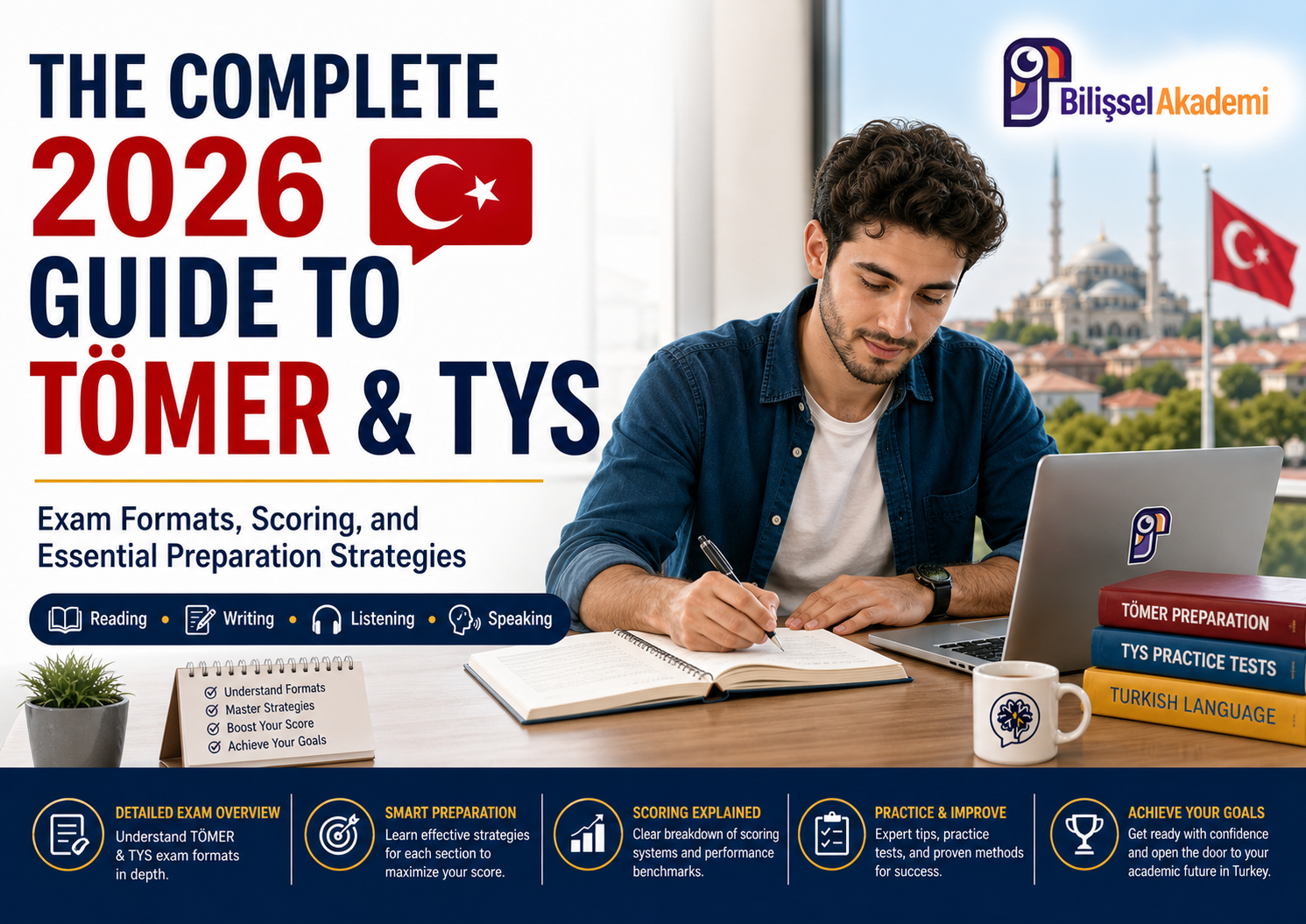
🎓 The Complete 2026 Guide to TÖMER & TYS:
Exam Formats, Scoring, and Essential Preparation Strategies
For international students, expats, and professionals in Turkey, Turkish proficiency exams such as TÖMER and TYS are important steps for academic admission, career planning, and official language documentation. These exams measure whether a learner can understand, speak, write, and use Turkish effectively in real-life, academic, and professional settings.
The TYS is developed by Yunus Emre Institute and assesses reading, listening, writing, and speaking skills; it is organized internationally and aligned with CEFR language levels. TÖMER exams, on the other hand, are usually administered by university language centers, and their formats may vary by institution.
🏫 What Is TÖMER?
TÖMER refers to Turkish teaching and language assessment centers, usually connected to universities. Many international students need a TÖMER certificate to prove that their Turkish is strong enough for university education in Turkey.
A typical TÖMER exam evaluates core language skills such as reading, writing, listening, dialogue, and individual speaking. Some institutions also use placement exams, course completion exams, and proficiency exams depending on the learner’s goal.
- Reading and understanding
- Writing
- Listening comprehension
- Dialogue or spoken interaction
- Individual speaking
🌍 What Is TYS?
TYS, or Turkish Proficiency Exam, is a standardized Turkish language proficiency exam developed by Yunus Emre Institute. It measures Turkish ability in reading, listening, writing, and speaking, and successful candidates receive a Turkish Proficiency Certificate according to their score level.
📅 2026 TYS Exam Dates
For 2026, one announced TYS exam date is May 17, 2026.
Applications are listed between March 23, 2026 and April 17, 2026. Candidates should always check the official application system before planning, because dates and centers may change.
TÖMER vs TYS: Key Differences
The most important difference is that TÖMER exams may differ from one university center to another, while TYS is a more standardized proficiency exam. This is why students should prepare not only for general Turkish, but also for the specific exam format they will take.
TYS Exam Format
The TYS measures four main skills: reading, listening, writing, and speaking. The exam is reported as having three sessions, with reading, listening, and writing conducted as group sessions and speaking conducted individually. The total exam duration is 180 minutes.
- Reading: Understanding written Turkish texts
- Listening: Understanding spoken Turkish
- Writing: Producing clear and structured Turkish texts
- Speaking: Communicating fluently and appropriately
TÖMER Scoring and Levels
TÖMER scoring may vary by institution. For example, one university TÖMER model evaluates proficiency according to CEFR levels from A1 to C2 and requires minimum performance in each skill area.
- A1-A2: Basic Turkish
- B1-B2: Intermediate Turkish
- C1-C2: Advanced academic and professional Turkish
Essential Preparation Strategies for the 4 Core Skills
📖 Reading Preparation
Reading sections usually test vocabulary, grammar awareness, sentence meaning, paragraph understanding, and the ability to find details in a text. Many students lose points because they read too slowly or try to translate every word.
- Read short Turkish texts every day.
- Practice identifying the main idea quickly.
- Learn common academic and everyday vocabulary.
- Review suffixes, noun cases, and verb forms.
- Practice with timed reading exercises.
🎧 Listening Preparation
Listening is difficult for many learners because spoken Turkish can feel fast. Learners may know the words in writing but fail to recognize them in natural speech.
- Listen to Turkish conversations at different speeds.
- Practice taking short notes while listening.
- Focus on keywords instead of translating every sentence.
- Review common question patterns and connectors.
- Use exam-style listening practice regularly.
✍️ Writing Preparation
Writing requires more than vocabulary. Students need correct grammar, clear sentence structure, logical paragraphs, and appropriate formal style. Apps rarely give detailed writing feedback.
- Practice writing short essays, emails, and opinion paragraphs.
- Use clear introduction, development, and conclusion structure.
- Review common linking words such as çünkü, ancak, ayrıca, bu nedenle.
- Get corrections from a qualified Turkish teacher.
- Rewrite corrected texts to avoid repeating the same mistakes.
🗣️ Speaking Preparation
Speaking sections test fluency, pronunciation, grammar accuracy, vocabulary range, and the ability to respond naturally. Many learners understand Turkish but freeze under exam pressure.
- Practice answering common personal and academic questions.
- Record yourself and listen for grammar or pronunciation mistakes.
- Learn useful expressions for giving opinions.
- Practice speaking under time limits.
- Work with a tutor who can correct your mistakes immediately.
Why Personalized Exam Preparation Matters
TÖMER and TYS preparation is not only about studying more Turkish. It is about studying strategically. A learner who is strong in reading may still fail because of weak writing or speaking. Another learner may know grammar but lose points because they cannot respond fluently.
Personalized lessons help identify weak areas and create a focused plan. Instead of repeating general exercises, students work on the exact skills that affect their score.
A good preparation program should include:
- Level analysis before starting
- Reading, listening, writing, and speaking practice
- Grammar correction based on real mistakes
- Timed exam-style exercises
- Writing feedback from an expert teacher
- Speaking practice with immediate correction
Final Thoughts
TÖMER and TYS are important exams for learners who want to study, work, or build a future in Turkey. Both exams require more than memorized vocabulary. Students need strong grammar, active listening, structured writing, confident speaking, and familiarity with exam expectations. With the right preparation plan and professional feedback, learners can improve their weak areas, avoid repeated mistakes, and enter the exam with more confidence.